For more than 70 years, the US and UK have operated more than 500 naval reactors that have collectively travelled hundreds of millions of nautical miles (enough to circumnavigate the globe thousands of times) without adverse effect on human health or the environment – and have accumulated thousands of reactor years of safe operation.
A sophisticated security and safety architecture will surround Australia's nuclear-powered submarine program, building on our 70-year unblemished track record of operating nuclear facilities and conducting nuclear science activities.
As a responsible nuclear steward, Australia will manage all radioactive waste generated by its own Virginia Class and SSN-AUKUS submarines, including radioactive waste generated through operations, maintenance and decommissioning.
All waste, including spent fuel, will be managed safely, informed by international best practice and in accordance with Australia's international and domestic legal obligations and commitments.
Australia will continue to leverage decades of experience in safely and securely managing radioactive waste, and will be supported by the UK and US, whose experience and advice will support Australia in building this capability.
HMAS Stirling Radiological Environmental Monitoring Program
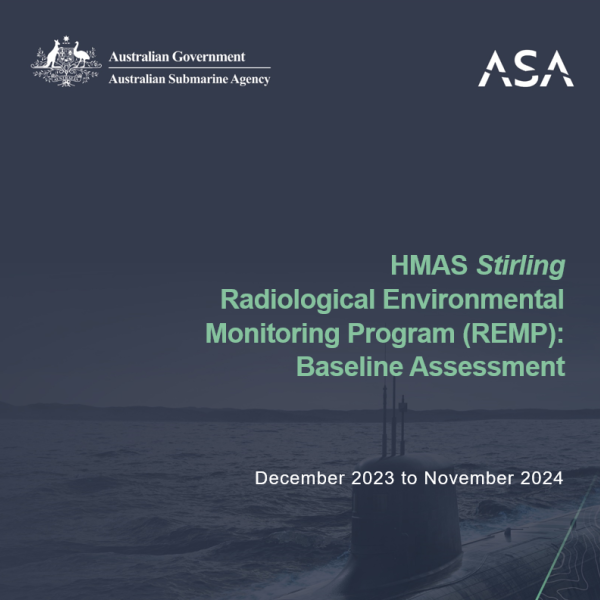
As responsible stewards of naval nuclear propulsion technology, the Australian Submarine Agency (ASA) is committed to protecting our people, the public and the environment from the harmful effects of ionising radiation. In line with this commitment, ASA has established a Radiological Environmental Monitoring Program (REMP) at HMAS Stirling. ASA conducted a baseline environmental radiological assessment during 2024. This assessment establishes the environmental radiological baseline at Stirling prior to the commencement of increased Nuclear-Powered Submarine (NPS) visits by the UK and US under Submarine Rotational Force West (SRF-West).
The baseline assessment for HMAS Stirling will inform an ongoing REMP, which will be maintained for the lifetime of the NPS program.
Baseline Assessment
This baseline assessment establishes a clear, evidence-based understanding of existing levels of radioactivity in the local environment. This baseline is a reference point for future comparisons.
The baseline assessment for HMAS Stirling was conducted over a 12-month period with a total of 263 samples collected and analysed. Overall, the results of the assessment determine that the radiological characterisation at HMAS Stirling is consistent with background conditions for both natural and anthropogenic radionuclides and isotopes within Australia.
This baseline assessment will be used to inform the continuous REMP at HMAS Stirling. Results collected through the REMP will be compared on an annual basis to the levels established in this report. The ASA is committed to ensuring that the NPS program meets the highest standards of environmental protection and provides transparency of results to foster confidence in the community.
Environmental monitoring
Learn how the ASA is monitoring and protecting the environment through its Radiological Environmental Monitoring Program at HMAS Stirling.